Recombinant AAV Replacement
The SRP-9003 (Bidridistrogene Xeboparvovec) Paradigm
The most clinically mature therapeutic strategy for LGMD R4 (LGMD2E) is adeno-associated viral (AAV) gene transfer, designed to deliver a full-length wild-type human SGCB coding sequence directly into skeletal and cardiac muscle fibers.
Recombinant Vector Architecture & Genetic Payload
Designed to deliver full-length wild-type human β-sarcoglycan cDNA directly into skeletal and cardiac muscle fibers while minimizing off-target hepatotoxicity.
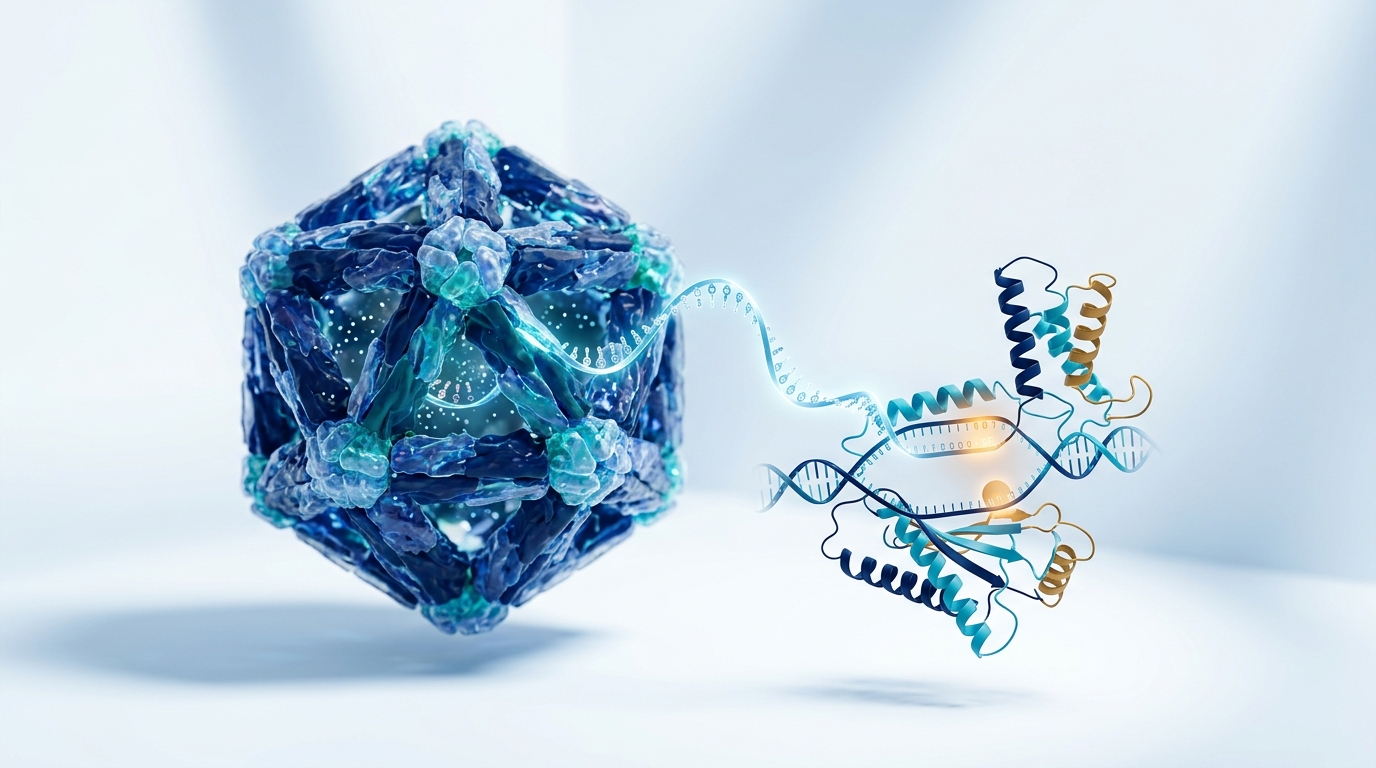
Vector Architecture: AAVrh74.MHCK7.hSGCB
Derived from non-human primates; displays strong tropism for both skeletal striated muscle and deep cardiomyocytes with lower baseline seroprevalence in human pediatric populations than AAV9 or AAV2.
A hybrid murine creatine kinase promoter/enhancer with a cardiac regulatory element, restricting transgene expression selectively to striated muscle and heart while minimizing non-target liver transcription.
Full-length 318 aa human β-sarcoglycan cDNA (35 kDa) configured without truncations, fully competent to nucleate the assembly of endogenous α-, γ-, and δ-sarcoglycans at the sarcolemma.
Clinical Trial Evidence & 2025–2026 Regulatory Status
Evaluated a single systemic IV infusion of 7.41 × 10¹³ vg/kg in 11 ambulatory (Cohort 1) and 6 non-ambulatory (Cohort 2) patients (enrollment and dosing completed December 2024). Day 60 biopsy results demonstrated statistically significant β-sarcoglycan reconstitution:
- Ambulatory (n=11): Mean change of +43.4% percent positive fibers (PPF, P < .001).
- Non-Ambulatory (n=6): Mean change of +23.9% PPF (P < .02).
- Restored membrane colocalization of the sarcoglycan complex.
Published in Nature Medicine (Mendell et al. 2024, PMID: 38177855; preclinical foundation Pozsgai et al. Mol Ther 2017, PMID: 28284983). Six pediatric patients (ages 4–15) received 1.85 × 10¹³ vg/kg (Cohort 1, n=3) or 7.41 × 10¹³ vg/kg (Cohort 2, n=3):
- Day 60 expression: 36.2% (Cohort 1) and 62.1% (Cohort 2) of normal β-SG.
- Sustained NSAD motor scores and CK reductions in 2-to-5 year follow-ups.
- Adverse events included vomiting and transient GGT/liver enzyme elevations managed with corticosteroids.
To prevent false hope regarding immediate commercial availability, families and clinicians must note that in July 2025, following severe AAVrh74-associated acute liver injury events in non-ambulatory Duchenne muscular dystrophy studies, Sarepta Therapeutics paused its investigational LGMD pipeline during a strategic restructuring, and on July 21, 2025, the U.S. FDA placed a formal clinical hold on Sarepta's investigational LGMD gene therapy trials (including SRP-9003) and revoked the rAAVrh74 Platform Technology Designation.
What This Means Scientifically: While Phase 1/2 (PMID: 38177855) and Phase 3 EMERGENE biopsies prove that systemic SGCB gene transfer successfully restores β-sarcoglycan protein at the human sarcolemma, regulatory BLA progression and patient access remain gated by resolution of vector-class hepatotoxicity and FDA safety requirements.
Small-Molecule Proteostasis Rescue (Preclinical)
CFTR Corrector C17 & ER Quality Control Modulation for Missense SGCB
Unlike nonsense alleles (such as c.552T>G / p.Tyr184*), missense mutations like c.341C>T (p.Ser114Phe) produce a full-length polypeptide that is prematurely destroyed by endoplasmic reticulum-associated degradation (ERAD). Peer-reviewed European research consortia have demonstrated that small-molecule folding correctors can rescue missense β-sarcoglycan in patient cells.
CFTR Corrector C17 in β-Sarcoglycanopathy
In a landmark study by Prof. Dorianna Sandonà's group at the University of Padova (Scano et al. Int J Mol Sci 2024, PMID: 39769077; Benetollo et al. Biochem Pharmacol 2025, PMID: 39864467), small-molecule CFTR correctors—particularly corrector C17—prevented ubiquitin-proteasome degradation of missense β-sarcoglycan mutants and restored the entire tetrameric sarcoglycan complex at the sarcolemma in primary LGMD2E/R4 patient myotubes, significantly reducing creatine kinase (CK) release under osmotic stress.
ERAD Escape & Functional Competency
Foundational work at Généthon (Soheili et al. Hum Mutat 2012, PMID: 22095924) established that 22 of 25 tested sarcoglycan missense mutations cause ER retention rather than catalytic loss of binding, and that inhibiting ER α-mannosidase I allows folding-competent missense subunits to reach the plasma membrane.
Genome Editing Horizons (Theoretical & Early Preclinical)
Base Editing & Prime Editing Feasibility Analysis
Unlike AAV gene addition (which introduces an extrachromosomal episome), precision genome editing aims to permanently repair the native chromosomal locus. Important Clinical Reality: While Adenine Base Editing has been demonstrated in primary human muscle stem cells for α-sarcoglycan (SGCA; Escobar, Spuler et al. JCI Insight 2021, PMID: 33848270), there are currently no active human clinical trials for CRISPR, base editing, or prime editing in SGCB (LGMD R4). The mechanisms below represent theoretical allele-specific blueprints for future preclinical research.
Adenine Base Editing (ABE): C·G → T·A Reversion
The c.341C>T missense mutation in Exon 3 (codon 114: TCT → TTT) is a canonical transition (C·G → T·A). On the complementary antisense strand, the mutant base is Adenine (A).
TTT (Phe) to wild-type TCT (Ser).
Technical Hurdles to Solve: Because codon 114 is TCT (antisense AGA, mutated to AAA), an adjacent "bystander" adenine exists within the deamination window that requires high-precision context-specific deaminases to prevent unintended synonymous or nonsynonymous bystander edits.
Prime Editing (PE): Amber Stop (TAG) Overwrite
The c.552T>G nonsense mutation in Exon 4 is a transversion (T·A → G·C) that converts wild-type Tyrosine codon 184 (TAT / mRNA UAU) into an amber premature stop codon (TAG / mRNA UAG). Standard base editors (CBE/ABE) cannot catalyze T → G transversions.
TAG (UAG) → wild-type Tyrosine TAT (UAU).Technical Hurdles to Solve: Prime editor constructs (~6.3 kb) exceed single-AAV packaging limits (~4.7 kb), requiring dual-AAV split-intein vectors or future muscle-tropic non-viral delivery systems with significantly higher in vivo skeletal muscle efficiency than currently available.
Next-Generation In Vivo Delivery: Overcoming AAV Limits with LNPs & eVLPs
The ultimate success of CRISPR and base editing in monogenic myopathies depends on delivery. Because permanent expression of bacterial Cas9 protein causes immune rejection and off-target cleavage, the field is pivoting toward transient non-viral delivery:
Lipid nanoparticles engineered with supplemental biophysical lipids that redirect biodistribution away from the liver and directly to skeletal muscle and cardiac myocytes. Can deliver mRNA encoding base editors for short 24–48 hour pulses.
Protein capsids that deliver pre-assembled Cas9/base editor ribonucleoprotein (RNP) complexes directly into cells without carrying viral DNA. Zero genomic integration risk and fully compatible with redosing.
Next: The 4-Layer Cytoprotective Peptide Shield
Examine the downstream biophysical membrane sealants and CRO synthesis specifications.