biotech Open-Science Consortium Peer-reviewed literature • Clinical trial tracking • Translational research audit for Limb-Girdle Muscular Dystrophy R4 (LGMD2E).
β
SGCBResearch LGMD R4
shield Downstream Cytoprotection • Peer-Reviewed Pathways vs. Theoretical In Silico Hypotheses

Downstream Cytoprotective Pathways & Conceptual Scaffolds

An evidence-based evaluation of the four downstream pathological cascades in β-sarcoglycanopathy—separating peer-reviewed preclinical literature from unvalidated, AI-generated theoretical peptide designs.

warning
Critical Patient & Clinical Safety Warning DO NOT SYNTHESIZE FOR HUMAN USE

Theoretical In Silico Peptide Sequences Are Unvalidated Hypotheses — Not Clinical Treatments

While the four downstream biological pathways analyzed below (sarcolemmal resealing, IKK/NF-κB inhibition, calpain modulation, and inner mitochondrial cardiolipin protection) are grounded in peer-reviewed muscular dystrophy literature, the specific modified sequences proposed in the AI-generated synthesis reports (Sarcolemmal Sealant-C20, Stapled NBD-C18, and Cyclic Calpastatin 14-mer) are theoretical, in silico conceptual designs (Technology Readiness Level 1).

These conceptual sequences have NEVER been synthesized, tested in cell culture, evaluated in Sgcb-null mice, or tested for safety and toxicology in humans. They must NEVER be compounded, ordered from a peptide CRO for personal use, or administered to any human patient.

biotech Evidence vs. Hypothesis Audit

The 4 Downstream Targets in β-Sarcoglycan Deficiency

When β-sarcoglycan is absent from the sarcolemma, muscle fibers experience a four-stage secondary cascade: (1) mechanical lipid bilayer micro-tears, (2) chronic IKK/NF-κB inflammation, (3) Ca²⁺-driven calpain proteolysis, and (4) mitochondrial Ca²⁺ overload. Below, we compare what has actually been proven in peer-reviewed research against the conceptual sequences from the AI technical dossier.

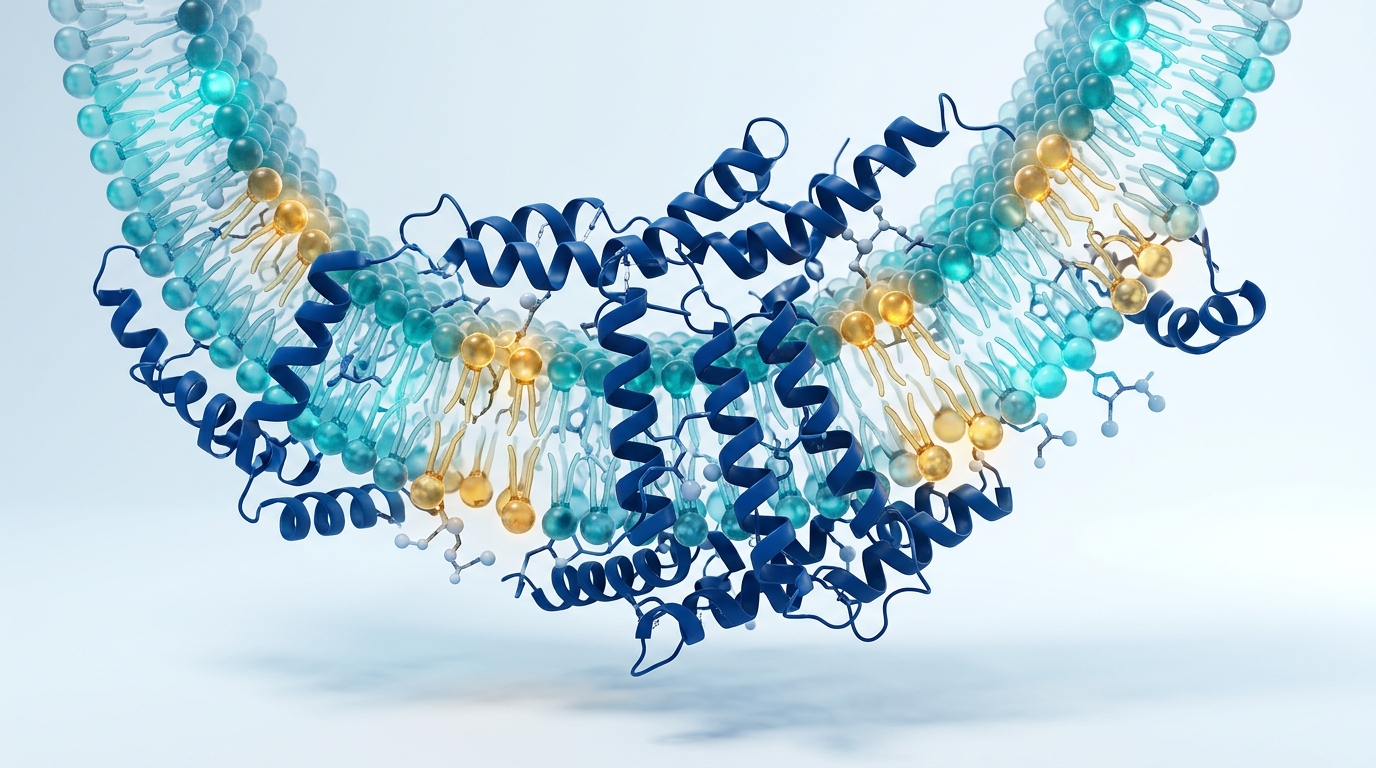
Abstract 3D biophysical visualization of synthetic membrane stabilizers interacting with a lipid bilayer
Conceptual Biophysical Model Downstream Cytoprotection
Pathway 1 • Membrane Resealing Sequence Status: Unvalidated In Silico Concept

Sarcolemmal Stabilization (P188 Copolymers vs. Conceptual Sealant-C20)

Verified Peer-Reviewed Literature: In published research, synthetic membrane sealing has been studied using non-ionic triblock copolymers such as Poloxamer 188 (P188) (Houang, Sham, Bates & Metzger, Skelet Muscle 2018, PMID: 30305165) and recombinant Annexin A6 protein, which partition into membrane lesions to blunt contraction-induced Ca²⁺ influx in dystrophic animal models.

AI Dossier Hypothesis ("Sealant-C20"): The AI-generated dossier proposed replacing polyether copolymers with a de novo 22-residue amphipathic α-helical peptide conjugated to a C20 diacid for albumin binding:

Theoretical Sequence (Untested in Lab / Animals): Ac-FKALKELLKAALELLKK([AEEA]2-γGlu-C20 diacid)-AALKAL-NH2
• Scientific Audit Caveat: Amphipathic cationic/helical peptides carry a well-known risk of lysing rather than sealing eukaryotic membranes if hydrophobic moment is not empirically titrated. This sequence has zero experimental data.
Literature Reference: Houang et al. Skelet Muscle 2018 (PMID: 30305165).
Pathway 2 • Anti-Inflammatory / NF-κB Sequence Status: Unvalidated Derivative

IKKγ / NEMO Uncoupling (NBD Peptide vs. Stapled NBD-C18)

Verified Peer-Reviewed Literature: The 11-mer NEMO-Binding Domain (NBD) peptide (TALDWSWLQTE, delivered via an Antennapedia cell-penetrating sequence) has been extensively validated in preclinical mdx mouse and Golden Retriever Muscular Dystrophy (GRMD) studies by Guttridge, Kornegay, and colleagues (Peterson et al. Mol Med 2011, PMID: 21267511; Kornegay et al. Skelet Muscle 2014, PMID: 25789154).

AI Dossier Hypothesis ("Stapled NBD-C18"): The dossier proposed replacing the Antennapedia CPP with an (i, i+4) hydrocarbon staple at positions 5 & 9 and a C18 diacid tail:

Theoretical Sequence (Untested in Lab / Animals): Ac-T-A-L-D-X1-S-W-L-X2-T-E-K([AEEA]2-γGlu-C18 diacid)-NH2 [S5 staple]
• Scientific Audit Caveat: Mutating Trp5 (W) in the core WSWL motif of NBD to a pentenylalanine staple (X1) could abolish binding to NEMO (IKKγ), as Trp5 is a critical aromatic contact residue in crystal structures.
Literature Reference: Peterson et al. Mol Med 2011 (PMID: 21267511).
Pathway 3 • Cytosolic Protease Defense Sequence Status: Unvalidated In Silico Concept

Calpain Inhibition (Endogenous Calpastatin vs. Cyclic 14-mer)

Verified Peer-Reviewed Literature: Calcium-activated neutral proteases (μ-calpain and m-calpain) are elevated in necrotic dystrophic fibers, and transgenic overexpression of endogenous calpastatin (CAST) reduced dystrophic pathology in mdx mice (Spencer & Mellgren, Hum Mol Genet 2002, PMID: 12354790), though subsequent pharmacological studies noted that calpain inhibition alone does not fully prevent degeneration.

AI Dossier Hypothesis ("Cyclic Calpastatin 14-mer"): The dossier proposed a head-to-tail macrocyclized 14-mer fragment from CAST subdomain 1B:

Theoretical Sequence (Untested in Lab / Animals): cyclo(Asp-Pro-Met-Ser-Thr-Ile-Tyr-Ile-Glu-Glu-Leu-Gly-Lys-Lys)
• Scientific Audit Caveat: Calpains are strictly intracellular (cytosolic) enzymes. This hydrophilic 14-mer lacks a cell-penetrating peptide (CPP) sequence, meaning it would have poor membrane permeability into intact myofibers without further delivery engineering.
Literature Reference: Spencer & Mellgren Hum Mol Genet 2002 (PMID: 12354790).
Pathway 4 • Mitochondrial Bioenergetics Real Clinical-Stage Compound (Other Diseases)

SS-31 / Elamipretide (Cardiolipin-Targeted Tetrapeptide)

Verified Peer-Reviewed Literature: Unlike Entities 1–3, SS-31 (elamipretide) is a real, extensively characterized aromatic-cationic tetrapeptide discovered by Prof. Hazel Szeto (Szeto, Br J Pharmacol 2014, PMID: 24117165). It selectively partitions across the inner mitochondrial membrane (IMM) to bind cardiolipin, stabilizing cristae architecture, improving electron transport chain coupling, and reducing mitochondrial ROS.

Published Chemical Structure: Evaluated in human clinical trials for Barth syndrome (TAZPOWER) and primary mitochondrial myopathy:

Verified Literature Structure (Szeto 2014, PMID: 24117165): D-Arg-2',6'-Dmt-Lys-Phe-NH2 [Dmt = 2',6'-dimethyl-L-tyrosine]
• Clinical Reality in LGMD R4: While elamipretide has human safety data in mitochondrial disorders and Barth syndrome, it has never been clinically trialed or approved for LGMD R4 / β-sarcoglycanopathy.
Literature Reference: Szeto HH Br J Pharmacol 2014 (PMID: 24117165).

In Vitro & Animal Research Standards

Laboratory Reagent Synthesis QC Parameters (Non-Human Research Only)

When academic neuromuscular laboratories synthesize tool peptides for in vitro cell culture (e.g., primary myotube assays) or animal model studies, standard solid-phase peptide synthesis (SPPS) quality control specifications apply to avoid confounding reagent artifacts (such as trifluoroacetate cytotoxicity):

Analytical Purity ≥98.0% RP-HPLC

Single symmetrical peak on C18/C4 analytical column; UV detection at 214 & 220 nm for in vitro assay consistency.

Mass Confirmation HRMS / ESI-MS

Deconvoluted molecular weight matches theoretical monoisotopic mass within ±0.5 Da.

Counter-Ion Exchange Acetate Salt (Low TFA)

Residual trifluoroacetate <0.1% w/w via HPLC/IC to prevent non-specific TFA toxicity in cultured myotubes.

Endotoxin Control <10 EU / mg

LAL endotoxin verification required prior to any in vitro macrophage or murine preclinical experiments.

Translational Governance

Mandatory Preclinical Validation Roadmap

Why theoretical peptide sequences cannot be jumped directly into human dosing: any candidate cytoprotective molecule must pass four rigorous experimental gates before human clinical investigation can be ethically considered.

Gate 1 • In Vitro Cellular Proof Primary Patient Myotubes

Cytotoxicity, Permeability & Osmotic CK Assay

Candidate compounds must first be tested in SGCB-deficient human myotubes (using established protocols such as Scano et al. 2024, PMID: 39769077) to prove they do not lyse cell membranes, verify intracellular uptake, and measure reduction of Creatine Kinase (CK) release under hypo-osmotic or mechanical stretch stress.

Gate 2 • Murine Disease Model Sgcb−/− Knockout Mice

In Vivo Pharmacokinetics & Specific Force

Empirical measurement of plasma and skeletal/cardiac muscle half-life (t½), Evans Blue dye sarcolemmal permeability, diaphragm and tibialis anterior specific tetanic force, and cardiac fibrosis in Sgcb-null mice (benchmark: Pozsgai et al. 2017, PMID: 28284983).

Gate 3 • GLP Safety & Toxicology Two-Species GLP Tox

Renal Clearance, Immunogenicity & Off-Target Safety

Lipidated and cyclic peptides can accumulate in proximal renal tubules (via megalin/cubilin uptake) or trigger anti-drug antibodies (ADAs) and mast-cell degranulation. Formal Good Laboratory Practice (GLP) toxicology in two species is mandatory prior to human exposure.

Gate 4 • Regulatory Authorization FDA IND / TGA CTN

GMP Manufacturing & Institutional Ethics Approval

Transition from research-grade SPPS to Good Manufacturing Practice (GMP) drug substance, review by an Institutional Review Board / Human Research Ethics Committee (HREC), and authorization of an Investigational New Drug (IND) application.

!
Absolute Therapeutic Contraindication

ActRIIB / Myostatin Antagonists in Unstabilized Muscle

Pharmacological antagonists of ActRIIB / myostatin (e.g., bimagrumab, taldefgrobep alfa, follistatin mimetics) and unshielded eccentric resistance exercises are strictly contraindicated in β-sarcoglycanopathy prior to verified membrane stabilization.

Biomechanical Hazard: Driving myofiber hypertrophy or heavy eccentric force while the sarcolemma lacks structural reinforcement converts micro-tears into massive ruptures.
Downstream Consequence: Massive calcium entry hyperactivates calpains, triggering acute rhabdomyolysis and accelerated fibro-fatty muscle replacement.

Membrane stabilization must be verified via sustained ≥40% drops in serum Creatine Kinase (CK) and myoglobin before considering any hypertrophic intervention.

Next: Clinical Biomarkers & Monitoring Protocol

View the 5-parameter biochemical and imaging schedule for clinical translation.

Proceed arrow_forward